Is Australia's builder shortage a door for Tanzanian tradespeople? What the closures really show
News · 2026-09-02 · 4 min read
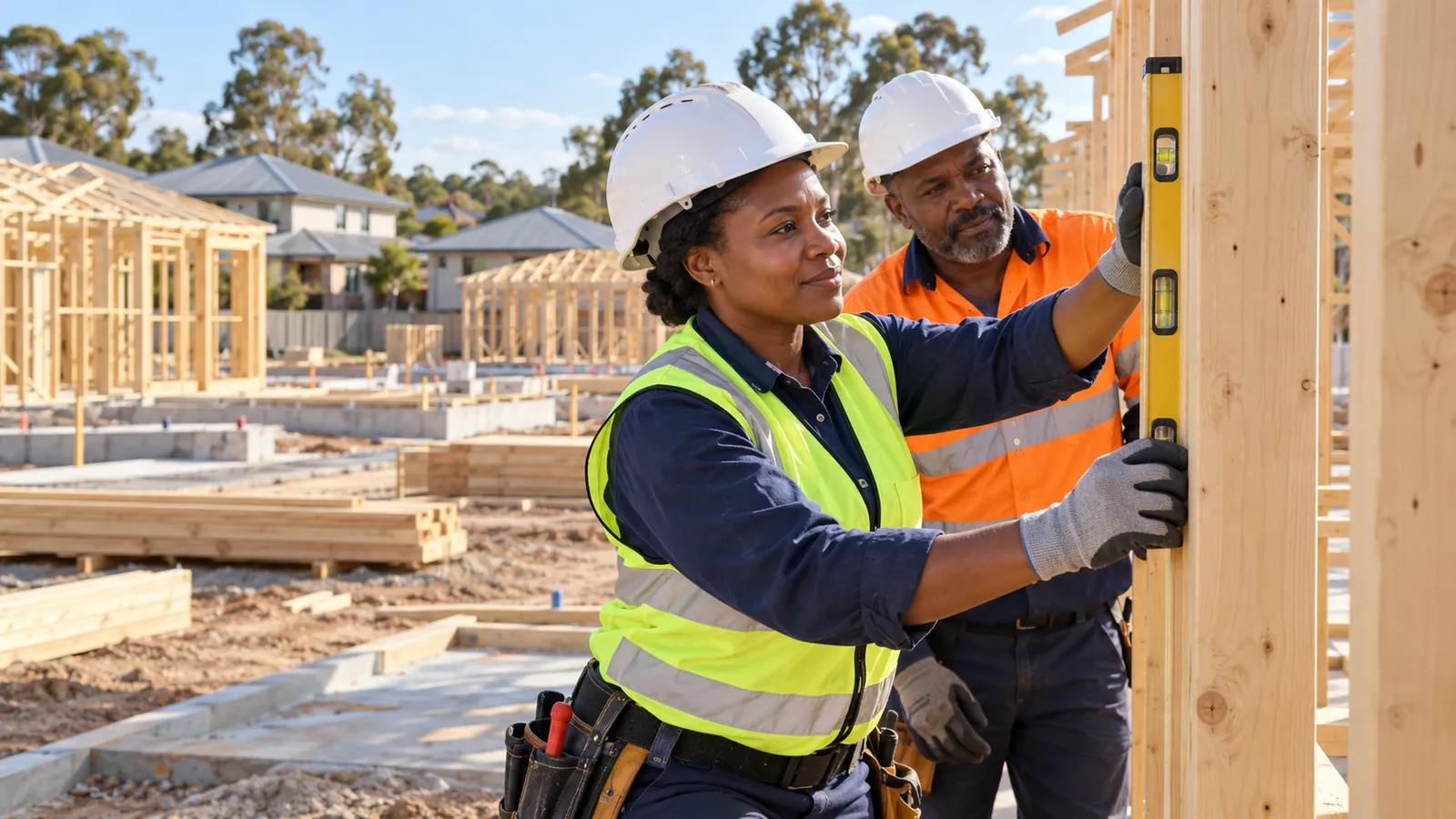
Think of a block of apartments that takes several years to build. For its buyers to get their homes, the contracted business must still exist at the end. In Australia that is increasingly a gamble, and that is the thread running through a wider story about a builder shortage and migration. Tradespeople in Dar es Salaam or Arusha can learn from it.
Closures at scale
More than 67,000 construction businesses shut last year. It was the fourth consecutive year above 64,000. Nearly half of the businesses that open do not make it past their third year, which is a survival rate not seen since the early 2010s. Confidence is low as well: sentiment fell sharply between 2025 and 2026, with rising costs, labour shortages and financing pressure at the top of the list.
The housing target under strain
- The National Housing Accord target is 1.2 million new homes by 2029.
- Official projections now put realistic completion at December 2030 nationally.
- In NSW the projection stretches to March 2032.
- Over 3,000 construction firms have closed in NSW in just two years.
Yet dwellings under construction reached 244,000 in the March 2026 quarter, the most on record since 1984. Demand and approvals are strong. What is missing is capacity.
Reading it as a migration story
When a sector loses so many firms every year, projects are not the shortage. People and stable businesses are. Overseas tradespeople, project managers and construction business owners are the sort of capacity the housing pipeline needs. Roughly half of construction decision-makers name policy settings among the top factors likely to hurt the sector over the next five years, so reform of skilled migration for carpenters, electricians, site supervisors and civil engineers is one of the levers under discussion. Pathways tied to in-demand trades may stay a priority, but no individual is promised anything.
A sense of scale
It helps to keep the figures side by side. Tens of thousands of businesses are folding every year, and the pace shows no sign of slowing. Nearly half of those that open will not last three years. At the same time more homes are under construction than ever before. The two facts together describe an industry stretched between too much work and too little stability. For overseas tradespeople, the lesson is to pair ambition with careful checks, since the same conditions that create openings also make employers harder to judge.
What it means for site and management roles
The shortage is not limited to people on the tools. Project managers, site supervisors and construction business owners from overseas are also described as the kind of capacity the pipeline needs. If you have supervised crews or managed budgets, those duties should be visible in your documents, because a supervisor and a labourer are assessed against different standards.
What to do from Tanzania
- State your trade clearly and gather evidence of projects.
- Find out what skills assessment, licence or registration your occupation needs in Australia. A VETA certificate never automatically equals any of them.
- Prepare other documents as required, and request police clearance from the Tanzania Police Force only when asked.
- Consult an agent registered with the Migration Agents Registration Authority (MARA).
Common mistakes in this field
Do not treat closures as vacancies. Do not ignore the stability of the employer you might join. Do not rely on an unverified claim about how quickly a visa can be obtained. Make your own case clear: for a trades worker, a CV built with Build AI CV should list site types, tickets, tools and supervisory duties. If your qualification is informal, RPLDirect describes how skills can be recognised for Australian qualifications.
Frequently asked questions
Why are so many construction businesses closing?
Rising costs, labour shortages and financing pressures are named as the leading concerns.
Is the housing target still 2029?
The target is 1.2 million homes by 2029, but projections now suggest later completion.
Which occupations are mentioned?
Carpenters, electricians, site supervisors and civil engineers.
Does closing firms mean fewer jobs?
Not necessarily. Work is plentiful but capacity is constrained.
What should I read next?
See our tradies by 2035 article and the bricklayers piece, and browse the visa guides.
Key takeaways
- More than 67,000 construction businesses closed last year.
- Dwellings under construction hit 244,000, the highest on record.
- The housing target is slipping to December 2030 nationally, March 2032 in NSW.
- Migration could help, with no promise to any individual.
- Check assessment and licensing and speak to an agent registered with MARA.
#builders #construction squeeze #australia #tradespeople #tanzania
 Is the door opening for Tanzanian builders? What Australia's tradie shortage figures really say
 72,000 more tradespeople by 2030: how should Tanzanian electricians read Australia's shortage?
 Will an Australian qualification lead to a skilled job? Findings Tanzanian students should read first